
At a glance
What you’re signing up for
Map
Find it on the map
Honest gut-check
Is this the right visit for you?
Paradise rewards visitors who plan around its constraints — the morning parking crunch, the wildflower window, the snowpack. Here's the honest picture.
Go for it if…
You want the wildflower meadows
Peak bloom runs mid-July to mid-August. This is the most flower-dense alpine zone in the state, and Paradise is where you experience it.
You want to see a glacier up close
Glacier Vista (reachable from Paradise) puts you 100 yards from the edge of the Nisqually Glacier. You can see the crevasses.
You're comfortable in snow terrain in summer
The upper Skyline Loop carries snowpack through late July most years. Microspikes help; avalanche beacon is not required.
You have a plan for the summer Paradise parking crunch
Mount Rainier is not requiring a timed-entry reservation for 2026 (the 2024–2025 pilot was discontinued; parking management replaces it). The Paradise lot still fills by mid-morning in summer — arrive early. The reservation has returned before, so confirm the current status on the NPS Mount Rainier page.
Maybe skip it if…
You're counting on midday summer parking at Paradise
The lot fills by mid-morning on peak summer days. No timed-entry reservation is required for 2026, but it has been required in past years and may return — confirm NPS status, and either way arrive by 8 AM.
You're expecting bare-ground trails in July
Most years the Skyline Loop upper section holds snow through mid-to-late July. Lower trails (Myrtle Falls, Nisqually Vista) are usually snow-free earlier.
You want a solitary experience
Paradise is the most visited area of the park. Arrive by 8 AM or after 4 PM to avoid the worst congestion at the visitor center and parking lot.
Weather is rolling in from the northwest
Rainier makes its own weather. Afternoon thunderstorms are common above treeline in summer — start early and be off the exposed upper trails by noon.
The experience
What it actually feels like
The key details on Paradise's access, timing, and what you'll actually encounter — from the parking lot to the Skyline Loop to the wildflower meadows.
What Paradise actually is
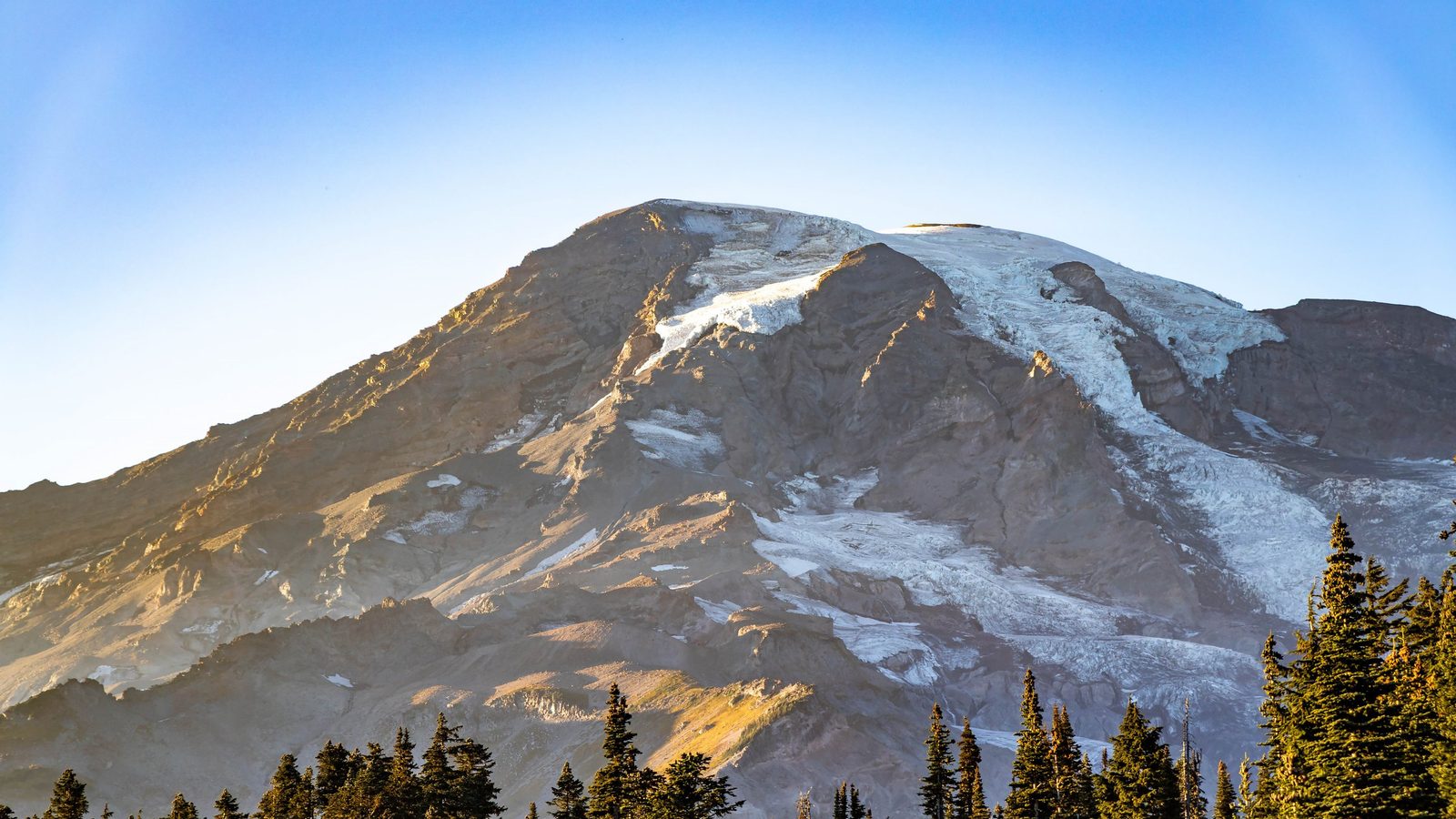
Paradise sits at 5,400 feet on Rainier's south slope — the main starting point for everything from 20-minute stroller walks to the Camp Muir summit approach. The visitor center, restrooms, and a snack bar are here. From the parking lot you can see the summit. On a clear day the scale of the thing is immediately apparent: the mountain is 14,411 feet tall and you are standing at the bottom of it.
Three zones operate at different difficulty levels from the same hub: the lower meadow trails (Myrtle Falls, Nisqually Vista — paved, accessible, under 1.5 miles round trip), the midrange alpine zone (Glacier Vista, Panorama Point — 3–4 miles, 1,200–1,400 ft of gain), and the full Skyline Loop (5.5 miles, 1,700 ft — the full wildflower experience).
The wildflower window
Paradise's wildflowers peak mid-July to mid-August. That's a four-week window in a typical year — narrower than most visitors expect when they plan a summer trip to "see the wildflowers." Lupine, paintbrush, avalanche lily, and Sitka valerian bloom in sequence across the meadows; the exact timing depends on snowpack from the previous winter.
Outside that window, the meadows are still beautiful — green above the snowline in June, golden and clear in September — but the bloom-and-blue-sky combination that produces the photos people associate with Paradise happens in that six-week July–August band.
The Skyline Loop — the full Paradise hike
The 5.5-mile Skyline Loop is the definitive Paradise hike. It climbs from the visitor center through wildflower meadows to Panorama Point (6,800 ft), with views across the south Cascades to Mount Adams and Mount St. Helens, then returns via the upper snowfields above Myrtle Falls.
The loop runs clockwise most easily — climbing the steeper western side and descending the gentler eastern slope. The upper mile of the route holds snow through late July most years; when snowpack is heavy, portions of the trail may not be passable without microspikes. Check the NPS conditions page the week of your visit.
On a clear mid-July morning with the wildflowers at peak and the summit above you, Paradise earns its name. The window for that exact combination is shorter than you think — plan for it specifically.
Shorter options from the same trailhead
If the full Skyline Loop is too long or the upper trails are snowed in, two shorter hikes from Paradise are worth the drive on their own: Myrtle Falls (1 mile, mostly paved, accessible for strollers) and Glacier Vista (3 miles, 1,200 ft, direct view of the Nisqually Glacier). Both are accessible earlier in the season when the Skyline upper section is still buried.
Timing
When to go
The wildflower window is four weeks. The parking competition is seasonal. Here's what each period actually offers.
- Temps
- 45–65°F
- Crowds
- Building
- Shuttle
- Check NPS.gov
- Permit lottery
- No timed entry for 2026 — confirm current NPS status
Paradise Road typically opens late May to early June. Upper Skyline Loop still heavily snowed in through July most years; lower trails (Myrtle Falls, Nisqually Vista) are snow-free earlier.
- Temps
- 55–72°F
- Crowds
- Peak
- Shuttle
- Check NPS.gov
- Permit lottery
- No timed entry for 2026 (required in past peak years — confirm NPS status)
Four-week window for wildflower bloom. The most competitive weeks for parking. Arrive by 8 AM to find a spot without the worst of the midday congestion.
- Temps
- 50–68°F
- Crowds
- Easing
- Shuttle
- Check NPS.gov
- Permit lottery
- No timed entry for 2026 — confirm current NPS status
Bloom is past peak but meadows are still green. Trails are fully clear of snow by August. Crowds begin to drop after Labor Day.
- Temps
- 30–52°F
- Crowds
- Light
- Shuttle
- Limited / not operating
- Permit lottery
- No timed entry
Paradise road stays open as long as conditions allow — often into November. Snow arrives on the upper trails first. Bring layers; weather changes fast at elevation.
Conditions at Paradise shift week to week — snowpack, road openings, entry-reservation status. Check current status before your drive: NPS Paradise current conditions
Gear
What to bring
The two things most visitors miss: checking the current entry-reservation status (none required for 2026, but it has returned) and microspikes if you're visiting before mid-August.
Bring it or turn around
Current entry status (check before you go)
No timed-entry reservation is required for Paradise in 2026 (the 2024–2025 pilot was discontinued; parking management replaces it). It has been required in past peak summers and may return — confirm the current status on the NPS Mount Rainier page before you finalize dates.
Check current status on NPS.gov →Microspikes (if visiting before mid-August)
The upper Skyline Loop carries snow through late July most years. Without traction, the snow-covered sections become genuinely treacherous on descent.
2+ liters of water per person
No water sources on the trail beyond the visitor center. The climb to Panorama Point at 5,400–6,800 ft is more demanding than it looks on paper.
Bring it and you'll be glad
Wind layer / rain jacket
Paradise is on the windward side of a 14,000-ft mountain. Even on blue-sky mornings, the upper meadows can be 15°F colder than the parking lot, and afternoon clouds build fast.
Sun protection
Above treeline at 5,400–7,000 ft, UV exposure is significantly higher than in the valley. Snow reflects it further.
Sunglasses
Snow on the upper trails in early summer is bright enough to cause snow blindness in a few hours without protection.
Leave it behind
Dogs
Not allowed on Paradise trails — only in the parking areas and on paved walkways within 50 feet of roads.
Backup plans
Always have a Plan B
Paradise access blocked or conditions wrong? Two legitimate alternatives that aren't a consolation prize.
Sunrise (northeast side)
6,400 ft · open mid-Jul through Sep · its own parking
Why this one The highest paved road point in Washington, with unobstructed views of Emmons Glacier and the northeast face. A completely different perspective on the mountain.
Sunrise has its own wildflowers and is often less crowded on days when Paradise fills first. The drive from Ashford adds about 2 hours; worth planning a full Sunrise day separately.
Longmire (on the Paradise road)
2,700 ft · open year-round · old-growth + historic district
Why this one Six miles inside the Nisqually entrance — the road you already take to Paradise — Longmire sits in low-elevation old-growth that stays open and snow-free long after the high meadows close. The Trail of the Shadows loops past mineral springs and an early homestead cabin in under a mile.
If Paradise is full, Longmire is the fallback you already drive past: a quieter, lower stop in the old-growth, with the historic National Park Inn and no reservation. A different side of the park, not a lesser one.
Glacier Vista via Avalanche Lily Trail
3.0 mi · 1,276 ft · Hard
Why this one Reaches snow earlier in the season but the payoff — a direct view of the Nisqually Glacier from the edge — is worth the earlier turnaround.
A shorter, harder alternative to the full Skyline Loop that still gets you above the meadows and into glacier-view territory.
Myrtle Falls
1.0 mi · 160 ft · Easy
Why this one Paved and accessible earlier in the season. The classic Paradise waterfall shot, with Rainier framed above the falls on clear days.
If conditions keep you off the upper trails, Myrtle Falls is the reliable fallback: a short walk with a genuine payoff and the summit visible behind the falls.
Save on Entry
One pass covers Mount Rainier — and every other US national park.
The America the Beautiful annual pass pays for itself in two or three park visits. Free entry, free passenger fees, and no more fumbling for a credit card at the kiosk.
 Buy your pass →
Learn more about the pass
Buy your pass →
Learn more about the pass
Ships from US Park Pass. Free shipping in the continental US.