
At a glance
What you’re signing up for
Map
Find it on the map
Honest gut-check
Is Half Dome right for your trip?
Half Dome is the park's most searched permit hike for a reason — and it's also the one most people underestimate. Here's the straight version so you can decide before you're on the trail.
Go for it if…
You have the permit — and the fitness for a full day
The cables are the goal, but 17 miles and 5,300 feet of gain is the entry fee. Most hikers take 10–14 hours. Plan for a very early start.
You want Yosemite’s summit experience
Half Dome is the Sierra skyline. The 360-degree view from the top — the Valley floor a vertical mile below, the entire granite park in every direction — is worth the permit fight.
You’re comfortable on steep, exposed terrain
The cable section is roughly 400 feet of near-vertical granite, holding chains bolted into the rock. Poles and pegs are spaced for steady movement; heights and physical demands are real.
Maybe skip it if…
You didn’t draw a permit
The cables are closed to anyone without one — no exceptions, and rangers check at the subdome base. See Plan B for the permit-free alternatives.
The cables are down
The cables come down each October and go back up in late May, depending on snow. No cables = no summit; the dome’s steep granite offers no safe route without them.
You’re not conditioned for a long mountain day
Half Dome is not a casual hike. The 17-mile round trip takes most hikers 10–14 hours. Underestimating it is the most common reason people need rescue on this route.
You’re hiking with young children
The cables require both hands and significant upper-body effort. The NPS strongly discourages children under 7 on the cables; older kids need to be genuinely capable and comfortable with steep exposure.
The experience
What it actually feels like
Walked through the way someone who's done it would tell you — the permit logistics, the approach routes, the cables, and what the summit is actually like.
The permit — how it works and what happens if you miss it
The Half Dome day-hike permit is the permit most people have heard of and the one most people miss. The preseason lottery runs in early March through Recreation.gov — you apply for specific dates in the window, results come back within a week. Quota is 225 day-hiker permits plus 26 through-hikers per day. In peak summer that lottery is genuinely competitive: apply for your best dates, and apply for alternates.
If you miss the preseason draw, there’s a second chance: a daily lottery releases roughly 50 permits two days before the target date. These are also competitive but faster to know the result — you apply at midnight and find out the next morning.
- Day-hike permit: required May through mid-October for the cable section
- Lottery opens in early March for the season ahead; also a daily lottery 2 days prior
- Backpackers with a Yosemite wilderness permit can summit without a separate day-hike permit
Getting there — Mist Trail vs. John Muir Trail
Two routes go up, one comes down, and you can mix them. The Mist Trail (from Happy Isles) is the classic: it passes Vernal Fall’s granite staircase and Nevada Fall’s thundering lip before joining the main Half Dome route at Little Yosemite Valley. The Mist Trail adds drama and cold spray but also crowds and steep slippery steps. The John Muir Trail takes a longer, less-exposed arc around the shoulder of Liberty Cap — more gradual, less slick, and quieter in the morning.
Most hikers go up via the Mist Trail and down via the JMT, or do the full 17.2 miles out-and-back on the JMT. The distance is similar; the difference is whether you want the waterfall experience on the way up or down.
The cables — subdome to summit
The cables are bolted into the granite face in two parallel runs — one to hold, one to share with descenders — and wooden planks are bolted to the rock as foot steps. The pitch is severe: you’re leaning into the mountain, moving from plank to plank, arms on the cables. It is physically demanding in a way that a long switchback hike is not. Plan for your arms to burn as much as your legs.
The most underestimated part is the subdome approach just below the cables: a loose-gravel scramble across open granite that’s already steep and exposed before you reach the main cable section. Some people turn around here. If the subdome feels like too much, the cables will be harder.
- Cable section: roughly 400 feet of near-vertical granite, two parallel cables, wooden plank steps every few feet
- Gloves provided at the base of the cables (a hardware store pair is better)
- Two-way traffic on a single route — expect waits in mid-morning
Half Dome is the park’s signature hike for the same reason it’s the park’s signature image: the dome is the thing. From the top, you understand the Valley in a way you can’t from the floor.
The summit
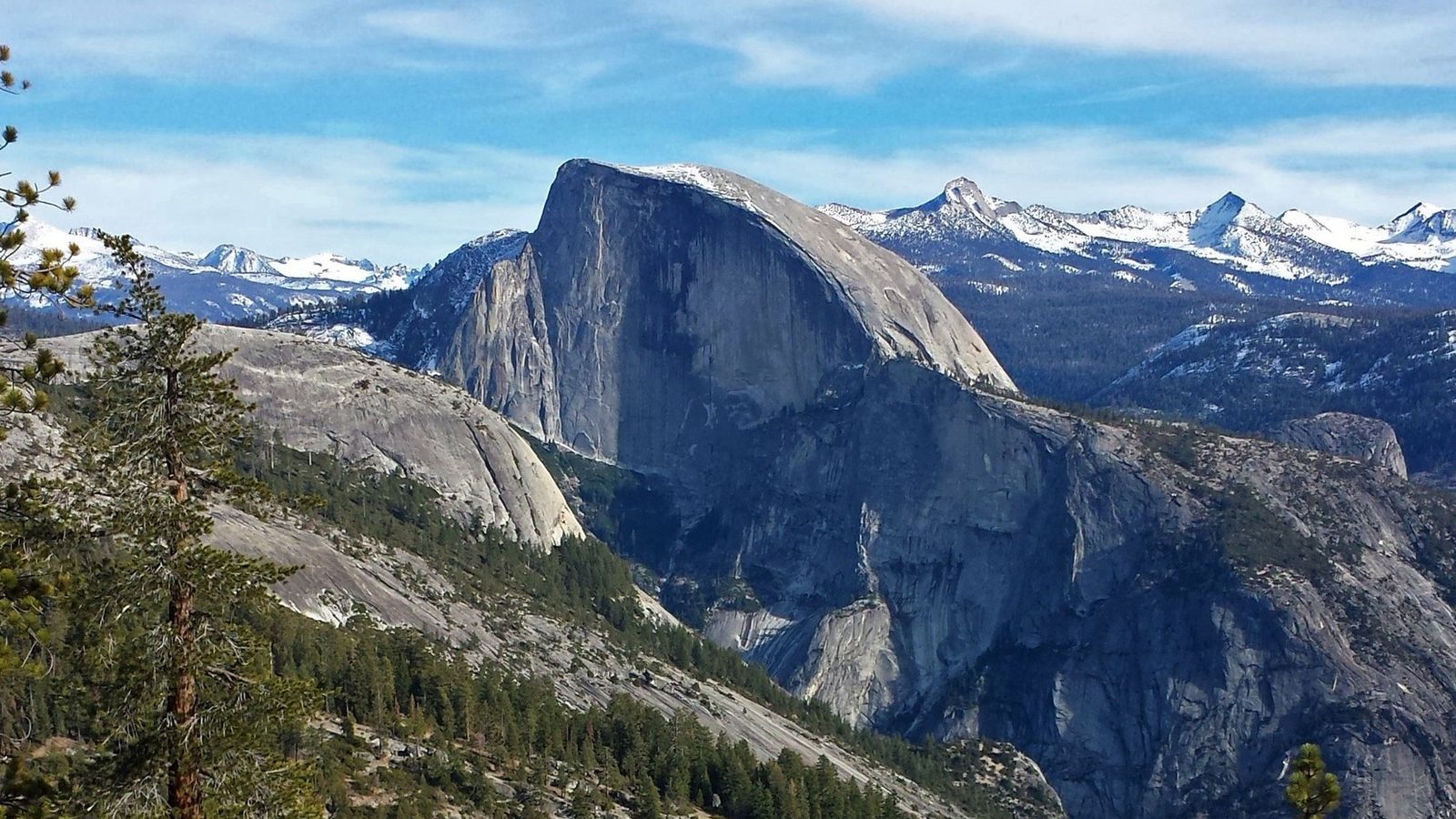
The summit is a broad, sloping granite plateau — much larger than people expect. You walk out onto open rock with the Valley visible directly below and the Sierra Nevada spreading in every direction. Half Dome’s sheer north face drops 2,000 feet straight down; it’s visible from the summit’s edge and is the most dramatic single feature on top.
Most hikers spend 30–60 minutes on the summit. Account for 30 minutes of descent just on the cables, then the long march back. If you’re aiming for the last shuttle from Happy Isles, know your turnaround time before you reach the top.
Timing
When to go
Season decides permit availability, cable access, and how early you have to start. Scan across and pick your window.
- Temps
- 50–75°F
- Crowds
- Light–moderate
- Shuttle
- Running
- Permit lottery
- Preseason lottery winners + daily lottery; cables go up late May
Waterfalls are at peak from snowmelt. Cable crowds are lighter before summer arrives. Snowpack can delay cable installation — verify before booking.
- Temps
- 65–90°F
- Crowds
- Peak
- Shuttle
- Running
- Permit lottery
- Most competitive lottery of the year; a Valley entry reservation can also apply in peak years (none for 2026 — confirm NPS status)
Hot on the exposed upper dome by midday. The cable queue gets long 10am–2pm. A 4am headlamp start is not optional in peak summer if you want the summit before crowds.
- Temps
- 45–75°F
- Crowds
- Easing
- Shuttle
- Running (reduced by October)
- Permit lottery
- Daily lottery easier to win; preseason lottery was March
Cooler temperatures, lighter cable queues, and better light for the views. Cables come down in mid-October — confirm the exact date for your trip year.
- Temps
- 20–55°F
- Crowds
- None
- Shuttle
- Limited
- Permit lottery
- Cables down — summit is inaccessible
The cables come down each fall and go back up in late May — confirm the current-year installation date on the NPS Yosemite page before planning around it. Without cables the granite face is not safely climbable. The subdome approach is an avalanche and hypothermia risk in winter.
Cable installation and removal dates shift year to year. Check current conditions and reports before you commit: See AllTrails conditions
Gear
What to bring
A 17-mile mountain day with a cable section at the top has a real gear list. These are the items where the why matters as much as the what.
Bring it or turn around
Your day-hike permit
Rangers check permits at the subdome base. No permit, no cables — and no one will waive it. Download a copy offline in case you lose signal.
Get the permit on Recreation.gov →At least 3–4 liters of water per person
There is no water on the upper route above Little Yosemite Valley. 17 miles of mountain hiking in warm temperatures requires substantially more water than a typical day hike.
Headlamp with fresh batteries
An early start is not optional on a 10–14 hour day. You’ll be on trail before dawn and may return after dusk. Two headlamps per group are smart.
Traction shoes or trail runners with sticky rubber
The subdome’s sloping granite and the cable section both require real grip. Sandals, flat-soled sneakers, and anything without defined tread are a slip hazard.
Bring it and you’ll be glad
Leather or work gloves
The steel cables will tear up bare palms. The NPS leaves disposable gloves at the cable base, but a proper grip glove is worth the small weight.
1,000+ calorie food supply per person
A 10–14 hour mountain day burns through calories fast. Pack more food than you think you’ll need — bonking on the cables is not a place you want to experience hunger.
Light rain layer and insulation
Afternoon thunderstorms build over the Sierra most summer days. The summit is exposed granite with no shelter — you want to be descending by early afternoon.
Trekking poles (for the approach)
Poles help enormously on the Mist Trail’s steep descent steps and the long switchbacks. Stow them at the cable base — you need both hands free on the cables themselves.
Leave it behind
Heavy camera gear
A DSLR and a tripod in a pack are weight and bulk you’ll feel by mile 12. A phone or a light mirrorless body in a hip pocket is the right call.
Cotton clothing
Cotton gets wet from Mist Trail spray and stays cold. Synthetic or merino base layers manage moisture far better on a long day with elevation gain.
Backup plans
Always have a Plan B
The permit lottery is competitive, the cables come down in October, and 17 miles is a real commitment. Whatever's in the way, there's a Yosemite day worth having on the other side of it.
Subdome approach (permit-free)
15.5 mi · 9–11 hr · Strenuous
Why this one You hike the full route to the base of the cables — 4,800 feet of gain — without needing the day-hike permit. The views from the subdome shoulder are 90% of the summit experience.
Park rangers check permits at the cable base, not below it. The approach itself — including the subdome — is permit-free. You see Half Dome from its own shoulder, looking back at the Valley.
Clouds Rest
12.6 mi · 7–9 hr · Strenuous
Why this one Higher viewpoint than Half Dome, with a view that looks down on the dome itself. No permit required and significantly fewer people.
Clouds Rest (9,926 ft) sits above Half Dome in the high country and is reached via Tenaya Lake on Tioga Road. The summit view is arguably better than Half Dome’s — you look down on the dome. Requires Tioga Road to be open (typically June–October).
Mist Trail to Nevada Fall
5.9 mi · 4–5 hr · Hard
Why this one Covers the Mist Trail’s best section — the granite staircase beside Vernal Fall and up to Nevada Fall — without the 17-mile commitment. Still requires real fitness.
The Mist Trail from Happy Isles to Nevada Fall is the section Half Dome hikers use anyway. You get both waterfalls, the spray wall, and the Sierra granite without needing a permit or a full day.
Upper Yosemite Falls Trail
6.7 mi · 5–7 hr · Hard
Why this one An 3,238-foot climb to the top of North America’s tallest waterfall, with a perspective that looks down on the Valley floor and El Capitan. Challenging but permit-free.
The Upper Falls trail earns its view — it’s steep and long — but it’s a self-contained Valley experience without the permit system. Spring is prime: water volume is at its peak.
Sentinel Dome
2.2 mi · 1.5–2 hr · Easy–Moderate
Why this one A 360-degree Sierra panorama — including a clear view of Half Dome itself — in a fraction of the distance. No permit, no cables, road access via Glacier Point Road (seasonal).
Sentinel Dome is the easiest high-country summit in Yosemite. The trailhead is off Glacier Point Road (open roughly June–November), and the top delivers the wide Sierra view many people expect from Half Dome with a fraction of the effort.
Glacier Point
0.3 mi · 30 min · Easy
Why this one Valley overlook at 7,214 feet — a genuine jaw-drop — with the bonus of looking directly at Half Dome’s sheer face from eye level. Roadside-accessible when Glacier Point Road is open.
You drive to the Glacier Point parking area and walk a short paved path to the overlook. Half Dome, Nevada Fall, and the entire Valley floor are below you. It is the best view per mile of walking in the park.
Save on Entry
One pass covers Yosemite — and every other US national park.
The America the Beautiful annual pass pays for itself in two or three park visits. Free entry, free passenger fees, and no more fumbling for a credit card at the kiosk.
 Buy your pass →
Learn more about the pass
Buy your pass →
Learn more about the pass
Ships from US Park Pass. Free shipping in the continental US.