
At a glance
What you’re signing up for
Map
Find it on the map
Honest gut-check
Is this hike right for you?
The Navajo Loop is short and spectacular, and almost everyone can do it — but the climb back out at altitude is the honest catch. Here’s the straight version so you can decide before you start down.
Go for it if…
You want to walk among the hoodoos, not just look at them
This is the most direct way off the rim and into the spires — Thor’s Hammer and the Wall Street fins are right beside the trail.
You can handle a steep, stair-stepped descent and climb
The Wall Street side is a tight series of switchbacks cut into the rock; the grade is steady both down and up.
You have an hour or two and want the signature Bryce hike
It is short enough for an afternoon and delivers the postcard — most people link it with Queen’s Garden for the full circuit.
Maybe skip it if…
The climb back up at altitude worries you
You descend first, which feels easy — then you climb 550 feet back to 8,000 feet with no shade. If that gives you pause, the flat Rim Trail is the better call (see Plan B).
It is icy, or Wall Street is closed
The Wall Street side closes seasonally for ice and rockfall. When it is shut, descend the Two Bridges side or take the Queen’s Garden route instead.
You are short on time and only want the view
The view from Sunset Point on the rim takes in Thor’s Hammer and the whole amphitheater with no descent at all.
The experience
What it actually feels like
Walked through the way a friend who’s done it would tell you — off the rim, down through Wall Street past Thor’s Hammer, and the climb back, with nothing dressed up.
Off the rim at Sunset Point
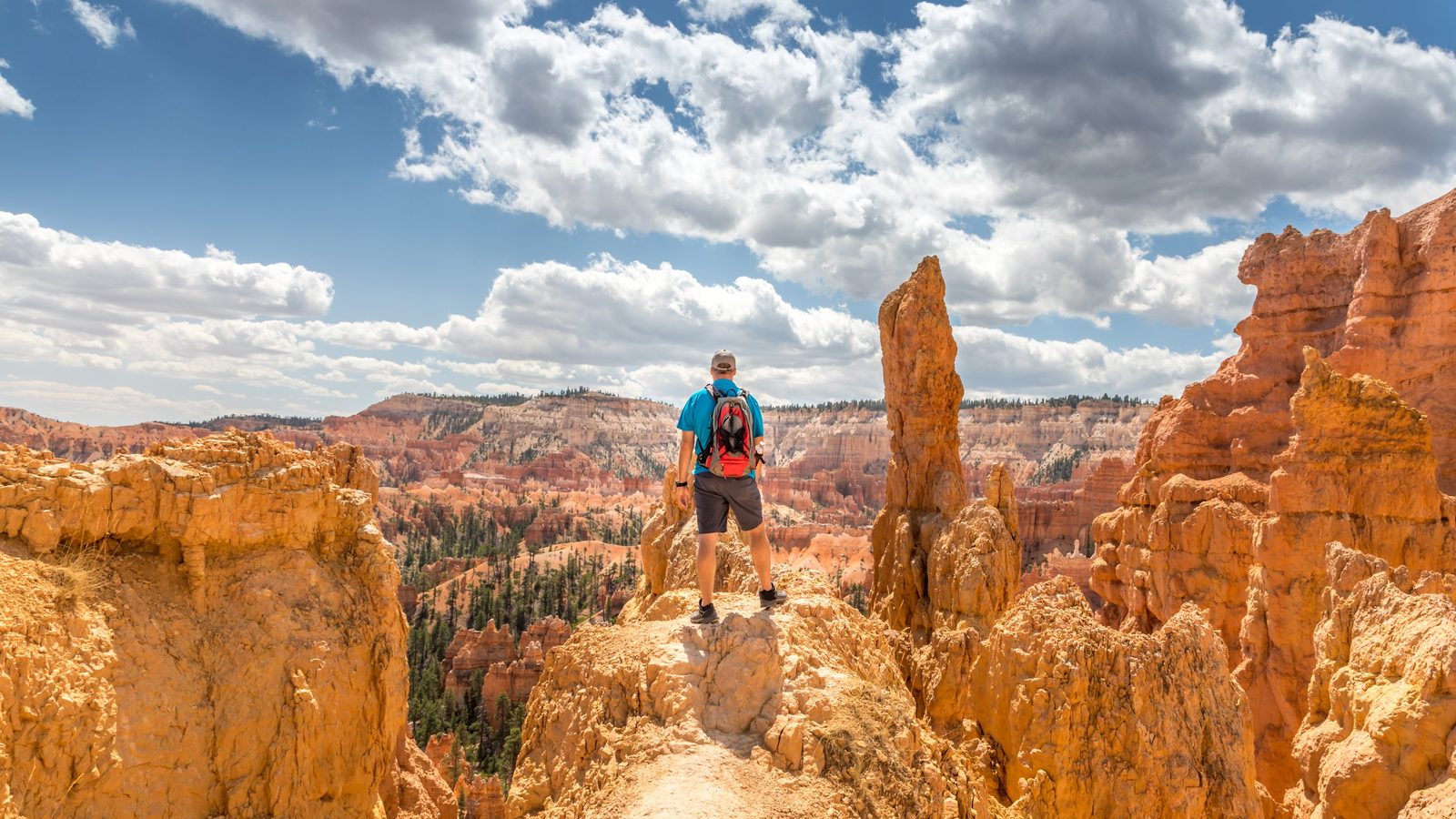
The loop drops straight off Sunset Point into the amphitheater. Within a few switchbacks you are among the hoodoos instead of looking down on them, and Thor’s Hammer — the balanced red block on a slender neck — stands right beside the trail. The walk down is genuinely easy; gravity does the work and the grade is gentle. It is worth being honest with yourself here, because every foot you descend is a foot you climb back.
- Starts at Sunset Point — a shuttle stop and a large lot
- The descent is the easy half; the loop climbs back to the same rim
Wall Street
The classic descent takes the Wall Street side: a narrow slot between two-hundred-foot fins where a pair of Douglas firs grow up toward a thin strip of sky, tightly stacked switchbacks zig-zagging down the chasm floor. It is the most photographed stretch of trail in the park. It also closes seasonally — ice in the cold months and rockfall risk shut it down — so check the park’s trail status before you count on it. When Wall Street is closed, the loop still goes via the Two Bridges side; you just miss the slot.
Back to the rim
The loop returns you to Sunset Point, a short walk from where you started. Most people who have any time left keep going: link the Navajo Loop to Queen’s Garden and you get the full Bryce circuit — down the gentle Queen’s Garden switchbacks from Sunrise Point, across the amphitheater floor, and up Wall Street — about 2.9 miles and the best two-to-three hours in the park.
Timing
When to go
Season decides the footing here — ice on the Wall Street switchbacks and whether the slot is even open. Scan across and pick your window.
- Temps
- 40–60°F
- Crowds
- Building
- Shuttle
- Starts in season
- Permit lottery
- None
Pleasant once the snow clears the switchbacks, but early spring can still hold ice on the Wall Street side — carry microspikes.
- Temps
- 60–80°F
- Crowds
- Peak
- Shuttle
- Running
- Permit lottery
- None
At 8,000 feet the temperature is comfortable even in July — the draw of Bryce in summer. Lots fill mid-morning; ride the shuttle and watch for afternoon thunderstorms.
- Temps
- 40–65°F
- Crowds
- Easing
- Shuttle
- Running (reduced late)
- Permit lottery
- None
Crisp air, thinning crowds, and the best light of the year on the hoodoos — arguably the finest window to walk the loop.
- Temps
- 20–40°F
- Crowds
- Lightest
- Shuttle
- Off
- Permit lottery
- None
Snow on the red hoodoos is the signature winter scene, but the Wall Street side commonly closes for ice and the switchbacks demand microspikes. Beautiful and quiet, with real footing hazards.
Trail conditions shift fast at altitude — ice on the switchbacks, the Wall Street closure, recent rockfall. Check recent reports before you drive out: See AllTrails conditions
Gear
What to bring
A short list for a short loop — with the reasoning attached, because at 8,000 feet the small things (water, spikes, a layer) are what keep an easy hike easy.
Bring it or turn around
At least 1–2 liters of water per person
There is no water and almost no shade below the rim, and the climb out at altitude pulls more out of you than the short distance suggests.
Shoes with real tread
The switchbacks are loose and dusty when dry and slick when wet; the descent is where people slip.
Bring it and you’ll be glad
Microspikes (late fall through spring)
Ice lingers on the shaded Wall Street switchbacks long after the rim looks clear — spikes are the difference between a walk and a fall.
A warm layer
The rim is cold at dawn even in summer, and you start there before you warm up on the descent.
Sun hat + sunscreen
Altitude and reflective rock make the sun stronger than the temperature suggests on the exposed climb out.
Leave it behind
A big pack
This is a one-to-two-hour loop — water, a layer, and a camera are all you need. A daypack is plenty.
Backup plans
Always have a Plan B
If the climb, the ice, or the clock rules out the loop, Bryce has a walk that still puts you among the hoodoos. Find your reason below.
Save on Entry
One pass covers Bryce Canyon — and every other US national park.
The America the Beautiful annual pass pays for itself in two or three park visits. Free entry, free passenger fees, and no more fumbling for a credit card at the kiosk.
 Buy your pass →
Learn more about the pass
Buy your pass →
Learn more about the pass
Ships from US Park Pass. Free shipping in the continental US.